
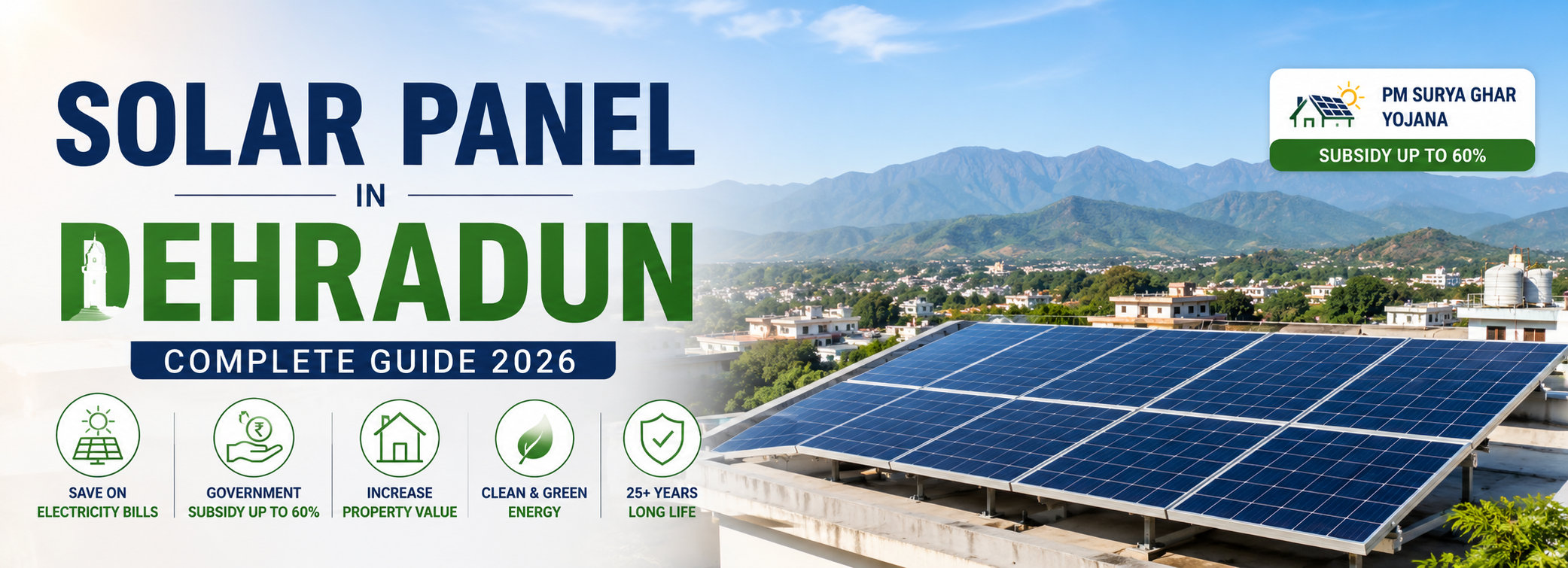
Electricity bills in Dehradun have been climbing steadily. For homeowners and businesses alike, this is a growing concern — and solar energy is quickly becoming the most practical answer.
Thank you for reading this post, don't forget to subscribe!Dehradun receives excellent sunlight throughout the year. Combined with central government subsidies under PM Surya Ghar Yojana, switching to solar in 2026 has never made more financial sense.
Whether you are a homeowner looking to cut monthly bills or a business owner wanting long-term energy independence, this guide covers everything you need to know about solar panel in Dehradun — costs, types, subsidies, and installation.
What Is a Solar Panel?
A solar panel is a device made of photovoltaic (PV) cells that converts sunlight directly into electricity. It is installed on rooftops or open land and works silently without fuel or moving parts. The electricity generated can power homes, offices, and factories while reducing dependence on the grid.
Why Solar Panel in Dehradun are Popular
Dehradun’s growing interest in solar is not a coincidence. Several factors are driving this shift:
Abundant Sunlight Dehradun receives an average of 5–6 peak sun hours per day. This makes it one of the more favorable cities in North India for rooftop solar systems.
Rising Electricity Bills UPCL tariffs have increased significantly over the past few years. A 3 kW solar system can reduce monthly electricity bills by ₹2,000–₹4,000 depending on usage.
Government Incentives The Indian government offers up to 60% subsidy on rooftop solar systems for residential consumers under PM Surya Ghar Yojana. This drastically reduces the upfront cost.
Long-Term Savings A well-installed solar system pays for itself within 4–6 years. After that, the electricity is essentially free for the remaining 20+ years of system life.
Environmental Benefits Solar energy produces zero emissions. For a city like Dehradun, which is fighting air quality challenges, this is a meaningful community benefit.
Types of Solar Panel in Dehradun
Monocrystalline Solar Panels
Monocrystalline panels are made from single-crystal silicon, making them the most efficient type available.
Features: Efficiency of 20–23%, sleek black appearance, compact size Benefits: Perform well in low-light conditions, longer lifespan (25+ years) Best Use: Residential rooftops with limited space, premium installations
These are the most popular choice for solar installation in Dehradun due to their reliability and efficiency.
Polycrystalline Solar Panels
Polycrystalline panels use multiple silicon fragments fused together. They are slightly less efficient but cost-effective.
Features: Efficiency of 15–18%, blue speckled appearance Benefits: Lower initial cost, good performance in direct sunlight Best Use: Budget-friendly residential setups, open rooftop spaces
They are a practical option for homeowners looking for a balance between cost and performance.
Bifacial Solar Panels
Bifacial panels generate electricity from both the front and rear surfaces by capturing reflected light.
Features: Dual-side generation, efficiency up to 22–25% Benefits: Higher energy output per panel, better ROI over time Best Use: Commercial and industrial rooftops, elevated mounting structures
For commercial solar installation in Dehradun, bifacial panels offer the best long-term returns.
Solar Panel Price in Dehradun (2026)
Solar panel price in Dehradun depends on system size, panel brand, and installation complexity. The table below provides estimated costs for 2026:
| System Size | Estimated Cost Before Subsidy | Estimated Cost After Subsidy |
|---|---|---|
| 1 kW | ₹65,000 – ₹75,000 | ₹45,000 – ₹55,000 |
| 2 kW | ₹1,20,000 – ₹1,40,000 | ₹80,000 – ₹95,000 |
| 3 kW | ₹1,70,000 – ₹1,95,000 | ₹1,05,000 – ₹1,20,000 |
| 5 kW | ₹2,70,000 – ₹3,10,000 | ₹1,90,000 – ₹2,20,000 |
| 10 kW | ₹5,20,000 – ₹5,80,000 | ₹4,20,000 – ₹4,70,000 |
Note: Prices are indicative and vary by brand, installation site, and current market rates. Subsidy is applicable for residential consumers only.
Government Solar Subsidy in Dehradun
PM Surya Ghar Yojana
Launched in 2024, PM Surya Ghar Muft Bijli Yojana is the central government’s flagship scheme to promote rooftop solar across India. Dehradun residents can directly benefit from this scheme.
Subsidy Structure:
- Up to 2 kW: 60% subsidy on benchmark cost
- 2 kW to 3 kW: 40% subsidy on the additional capacity
- Above 3 kW: No central subsidy, but state schemes may apply
Eligibility:
- Residential consumers with a valid electricity connection
- Property must be owned (not rented)
- The system must be installed through an empanelled vendor
Application Process:
- Register on the national portal: pmsuryaghar.gov.in
- Submit electricity bill and property documents
- Select an empanelled solar installer in Dehradun
- Get system installed
- Apply for net metering with UPCL
- Receive subsidy directly in your bank account after inspection
Solar subsidy in Uttarakhand makes rooftop solar one of the most financially attractive investments available to residents today.
Residential Solar Panel Installation in Dehradun
For homeowners in Dehradun, rooftop solar is one of the smartest long-term investments available.
A 3 kW system is typically sufficient for a mid-sized home consuming 300–350 units per month. It can reduce the electricity bill to near zero for most months and generate surplus units that earn credits through net metering.
Key Benefits for Homeowners:
- Monthly savings of ₹2,000–₹5,000 depending on consumption
- Payback period of 4–6 years
- System lifespan of 25 years with minimal maintenance
- Increase in property value
- Protection from future electricity rate hikes
For households with higher consumption — AC units, water heaters, electric vehicles — a 5 kW or 10 kW system is more appropriate.
Rooftop solar in Dehradun works particularly well for independent houses, villas, and ground-floor apartments with open roof access.
Commercial Solar Panel Installation in Dehradun
Businesses in Dehradun are increasingly turning to solar to control operating costs and meet sustainability goals.
Who Benefits Most:
Factories and Industrial Units: High electricity consumption means faster payback. A 50 kW–500 kW system can dramatically reduce demand charges and per-unit costs.
Hotels and Resorts: Dehradun’s growing hospitality sector spends heavily on electricity. Solar reduces operational costs while improving the brand’s green credentials.
Schools and Colleges: Educational institutions can redirect savings into infrastructure and salaries. Many schools have seen 40–60% reductions in electricity bills.
Hospitals and Clinics: Reliable solar power with battery backup ensures uninterrupted operations — a critical need for healthcare facilities.
Offices and Commercial Buildings: With net metering, surplus solar power during the day earns credits that offset night-time grid usage.
ROI for Commercial Solar in Dehradun: Most commercial systems achieve full payback in 3–5 years. Over a 25-year lifespan, a 100 kW system can save ₹80–₹120 lakh in electricity costs.
Solar Installation Process
Installing a rooftop solar system in Dehradun typically follows these steps:
- Site Survey — A technician visits your property to assess roof condition, orientation, shading, and available area.
- Roof Assessment — The structural integrity of the roof is evaluated to confirm it can safely support the solar panels and mounting structure.
- System Design — Based on your electricity consumption and roof size, a customized system layout is designed to maximize output.
- Quotation — A detailed cost estimate is provided, including panel brand, inverter type, structure, wiring, and installation charges.
- Subsidy Application — If eligible, the installer assists with PM Surya Ghar application and documentation submission.
- Installation — Panels, inverter, and wiring are installed by certified technicians, typically within 1–3 days for residential systems.
- Net Metering — The installer coordinates with UPCL to set up bidirectional metering, allowing surplus units to be exported to the grid.
- Commissioning — The system is tested, commissioned, and handed over with full documentation and warranty details.
Benefits of Installing Solar Panels in Dehradun
- Significant reduction in monthly electricity bills
- Protection from future UPCL tariff hikes
- Up to 60% government subsidy available for residential users
- Earn credits through net metering for surplus power
- Low maintenance — no moving parts, no fuel required
- 25-year panel performance warranty from reputed brands
- Reduces carbon footprint and supports clean energy goals
- Increases resale value of residential and commercial properties
- Supports Uttarakhand’s clean energy targets
- Energy independence from grid disruptions and outages
How to Choose the Best Solar Company in Dehradun
With many vendors now operating in the region, choosing the right solar company in Dehradun requires careful evaluation.
Experience and Track Record Look for a company with a verifiable portfolio of residential and commercial installations in Dehradun and Uttarakhand. Local experience matters because roof types, grid connectivity, and UPCL procedures vary regionally.
Panel and Equipment Quality Ensure the company offers panels from reputed brands (Tier 1 manufacturers) with at least 25 years of performance warranty and 10 years of product warranty.
Subsidy Assistance A reliable installer will help you through the entire PM Surya Ghar application process — not leave you to figure it out alone.
Net Metering Support The company should handle all coordination with UPCL for net metering registration, which is essential to maximize your solar savings.
After-Sales Service Solar systems operate for 25 years. Choose a company with a local service team that can respond quickly to performance issues or maintenance needs.
Transparent Quotation A trustworthy company provides itemized quotes with no hidden charges — covering panels, inverter, structure, wiring, and installation separately.
Addsun Energy Pvt. Ltd. is one of the established solar energy service providers operating in Dehradun and Uttarakhand, with experience across residential, commercial, and industrial solar installations. Their local presence and support for government subsidy applications make them a practical choice worth considering when shortlisting solar vendors.
Solar Panel Price Comparison Table
| Panel Type | Efficiency | Avg. Cost per Watt | Lifespan | Best For |
|---|---|---|---|---|
| Monocrystalline | 20–23% | ₹35–₹45 | 25–30 years | Homes, premium installs |
| Polycrystalline | 15–18% | ₹28–₹36 | 20–25 years | Budget residential |
| Bifacial | 22–25% | ₹40–₹52 | 25–30 years | Commercial, industrial |
| Half-Cut Monocrystalline | 21–24% | ₹38–₹48 | 25–30 years | Shaded or mixed rooftops |
| Thin-Film | 10–13% | ₹22–₹30 | 15–20 years | Flat surfaces, low budget |
Frequently Asked Questions (FAQs)
1. What is the cost of a solar panel system in Dehradun?
A 3 kW residential system costs approximately ₹1,70,000–₹1,95,000 before subsidy. After applying the PM Surya Ghar subsidy, the effective cost drops to around ₹1,05,000–₹1,20,000. Costs vary by panel brand and installation complexity.
2. Is government subsidy available for solar panels in Dehradun?
Yes. Under PM Surya Ghar Yojana, residential consumers in Dehradun are eligible for up to 60% subsidy on systems up to 2 kW, and 40% on the next 1 kW. The subsidy is credited directly to your bank account after installation and inspection.
3. How long does solar installation take in Dehradun?
For a standard residential rooftop solar system (1–5 kW), installation typically takes 1–3 working days. The complete process — from site survey to commissioning — usually takes 2–4 weeks, including subsidy application and net metering setup.
4. How much can I save on electricity bills with solar in Dehradun?
A properly sized solar system can reduce your electricity bill by 70–100% during peak sunlight months. Most 3 kW residential users report monthly savings of ₹2,500–₹4,500, depending on consumption patterns and UPCL tariff slab.
5. What is net metering and how does it work in Dehradun?
Net metering allows you to export surplus solar electricity to the UPCL grid and earn credits against your bill. When your system produces more than you consume — typically during midday — the excess units are recorded and adjusted in your next electricity bill.
6. How much maintenance do solar panels require?
Solar panels require very little maintenance. Cleaning the panels every 1–2 months to remove dust and bird droppings is usually sufficient. A periodic check of inverter performance and wiring connections once a year is recommended. Most quality systems come with remote monitoring apps.
7. What is the lifespan of a solar panel?
Quality monocrystalline and bifacial solar panels from Tier 1 manufacturers last 25–30 years. Most manufacturers offer a 25-year linear power output warranty, guaranteeing at least 80% efficiency at the end of the warranty period.
8. Can I install solar panels in a rented house in Dehradun?
Subsidy under PM Surya Ghar Yojana is available only to property owners. However, tenants can still install solar with the landlord’s consent — though they would not qualify for the central subsidy. Some installers offer rental or lease models worth exploring.
9. Are solar panels suitable for commercial properties in Dehradun?
Absolutely. Hotels, offices, schools, and factories in Dehradun are ideal candidates for commercial solar installation. Systems of 10 kW to 500 kW are common for commercial use, with typical payback periods of 3–5 years and lifetime savings running into lakhs of rupees.
10. Which government scheme supports solar energy in Uttarakhand?
PM Surya Ghar Muft Bijli Yojana is the primary central government scheme supporting rooftop solar in Uttarakhand. Additionally, the Uttarakhand Renewable Energy Development Agency (UREDA) periodically announces state-level incentives and empanels vendors for subsidized solar services in Dehradun and surrounding districts.
Our Solar & Energy Services in Uttarakhand
- Solar EPC Company in Dehradun
- Solar Plant Operation & Maintenance in Uttarakhand
- Solar Energy Training Institute in Dehradun
- EV Charging Station Installation in Uttarakhand
Conclusion
Solar energy is no longer a future option for Dehradun — it is a present-day financial decision that makes clear sense. With abundant sunlight, rising electricity tariffs, and a well-structured government subsidy program, the city is primed for rapid solar adoption in 2026. Whether you are a homeowner or a business operator, installing solar panel in Dehradun delivers measurable returns within a predictable timeframe.
The PM Surya Ghar Yojana makes this transition even more accessible by covering up to 60% of system cost for eligible residential consumers. Combined with net metering benefits from UPCL, the economics of rooftop solar in Dehradun are now genuinely compelling for a wide range of users across residential and commercial segments.
If you are evaluating solar services in Uttarakhand, Addsun Energy Pvt. Ltd. is a local provider with experience in residential, commercial, and industrial solar installation across Dehradun. Getting a site assessment and detailed quote from an established company is always the recommended first step before committing to any solar investment.