
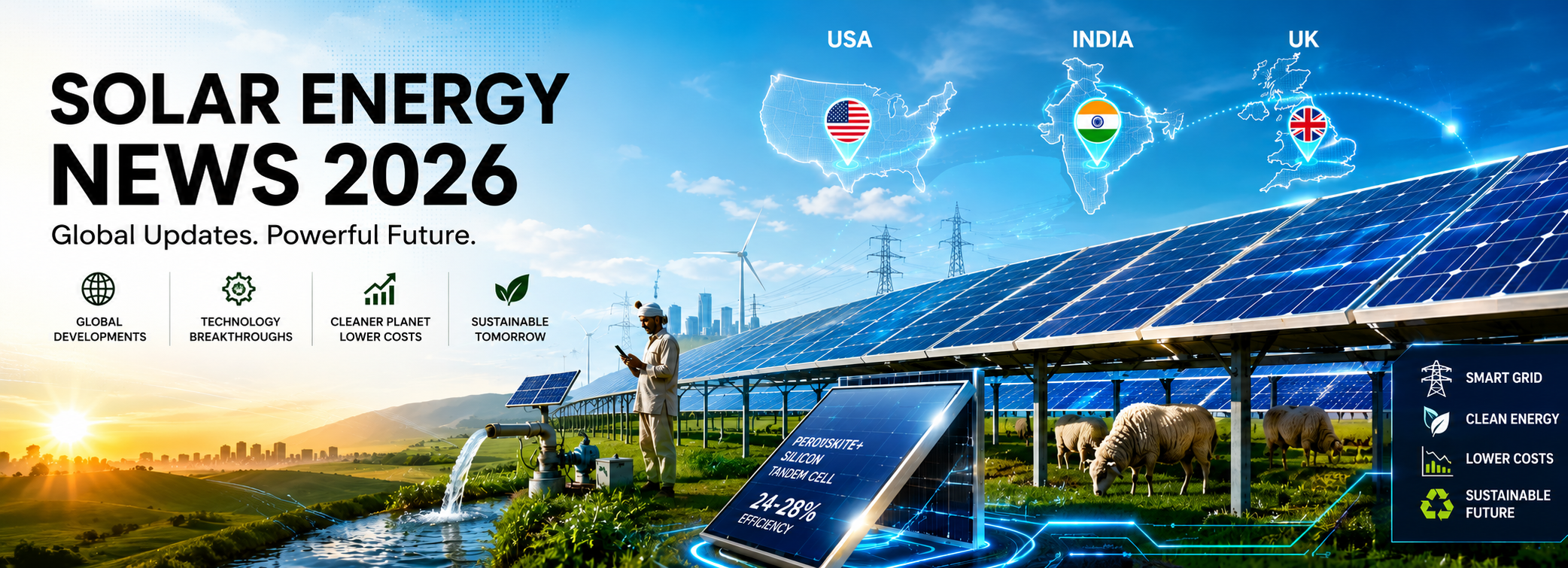
Solar Energy continues to lead the global shift toward clean, renewable power. As of June 2026, the industry is experiencing unprecedented growth, with record installations, technological advancements, and significant investments shaping the future of energy production. Solar Energy is no longer just an alternative — it has become a mainstream powerhouse driving economic and environmental progress worldwide.
Thank you for reading this post, don't forget to subscribe!In this comprehensive update, we cover the biggest stories, statistics, and trends in Solar Energy for 2026.
Solar Energy Boom in the USA {#usa}
The United States remains a leader in Solar Energy deployment. In 2025, the US solar industry installed approximately 43 GW of new capacity, marking the fifth consecutive year that solar was the top source of new power added to the grid.
PG&E has achieved a major milestone by connecting over 1 million customer solar systems to the grid, highlighting strong residential Solar Energy adoption. Texas continues to dominate with massive utility-scale projects, and solar generation there is poised to surpass coal in several metrics. Virginia is boosting local manufacturing with a new solar panel assembly plant.
Additionally, states like Indiana and California are setting new records, with solar accounting for a huge portion of new electricity capacity. Energy storage paired with Solar Energy is also expanding rapidly to manage grid stability.
Solar Energy Progress in India {#india}
India has emerged as a global Solar Energy powerhouse, surpassing the United States in annual capacity additions in recent years. The country added significant gigawatts through 2025-2026, with Maharashtra leading in off-grid solar pumps under the PM-KUSUM scheme — installing over 1 million units, contributing nearly 64% of the national total.
ACME Solar raised ₹2,800 crore via QIP to fuel expansion. Government policies, auctions, and infrastructure development are accelerating Solar Energy growth, helping farmers reduce diesel dependency and supporting rural electrification. India’s push aligns with its ambitious renewable energy targets, making Solar Energy central to its energy security and sustainability goals.
Global Solar Energy Records {#global}
Solar Energy installations surged dramatically in 2025. Globally, the world added hundreds of GW in the first half of the year alone, putting 2025-2026 on track for record-breaking totals. The United Kingdom set a notable single-day generation record of 15.2 GW.
An innovative trend in the USA and elsewhere involves sheep grazing on solar farms. This agrivoltaic approach keeps panels clean naturally while providing farmers with additional revenue from livestock. China continues to lead global additions, but growth in Europe, India, and the US remains robust.
New Solar Technology Breakthroughs {#tech}
Technological innovation is a major driver for Solar Energy. Perovskite-silicon tandem cells have seen remarkable progress, with lab efficiencies exceeding 34% and commercial modules reaching 24-28% efficiency. Companies like Oxford PV, LONGi, and Qcells are pushing boundaries, with some tandem cells hitting 28.6% on full-size formats.
These advancements promise cheaper, more efficient panels that could accelerate adoption. Stability improvements, such as better resistance to heat and light degradation, are also making perovskite technology closer to widespread commercialization.
Benefits and Challenges of Solar Energy {#benefits}
The benefits of Solar Energy are clear: it reduces greenhouse gas emissions, lowers electricity bills for households and businesses, and creates jobs across manufacturing, installation, and maintenance. Solar Energy systems require minimal maintenance and have a long lifespan, often 25-30 years or more.
However, challenges remain, including grid integration, supply chain issues, and the need for better energy storage solutions to handle intermittent generation. Policy support, such as tax incentives and streamlined permitting, continues to play a crucial role in overcoming these hurdles.
Why the Future of Solar Energy is Bright {#future}
Looking ahead, Solar Energy costs continue to decline while efficiency rises. Projections show massive capacity additions through 2026 and beyond, with the US alone planning nearly 70 GW in upcoming years. Global cumulative capacity is rapidly approaching multi-terawatt levels.
Governments worldwide are setting higher renewable targets, and private investments are pouring in. Solar Energy combined with storage and electric vehicles will play a pivotal role in decarbonizing the planet. From large-scale farms to rooftop installations, the technology is becoming more accessible and affordable for everyone.
In conclusion, 2026 is shaping up to be another transformative year for Solar Energy. Whether you’re a homeowner, business owner, or policymaker, staying informed about these developments is key to participating in the clean energy transition.